
Introduction: How Marketing Automation Is Changing Modern SEO
SEO is no longer limited to adding keywords, publishing blog posts, and checking rankings manually. Today, businesses need a smarter approach that connects search visibility, customer behavior, content performance, and lead generation.
This is where marketing automation and SEO work together.
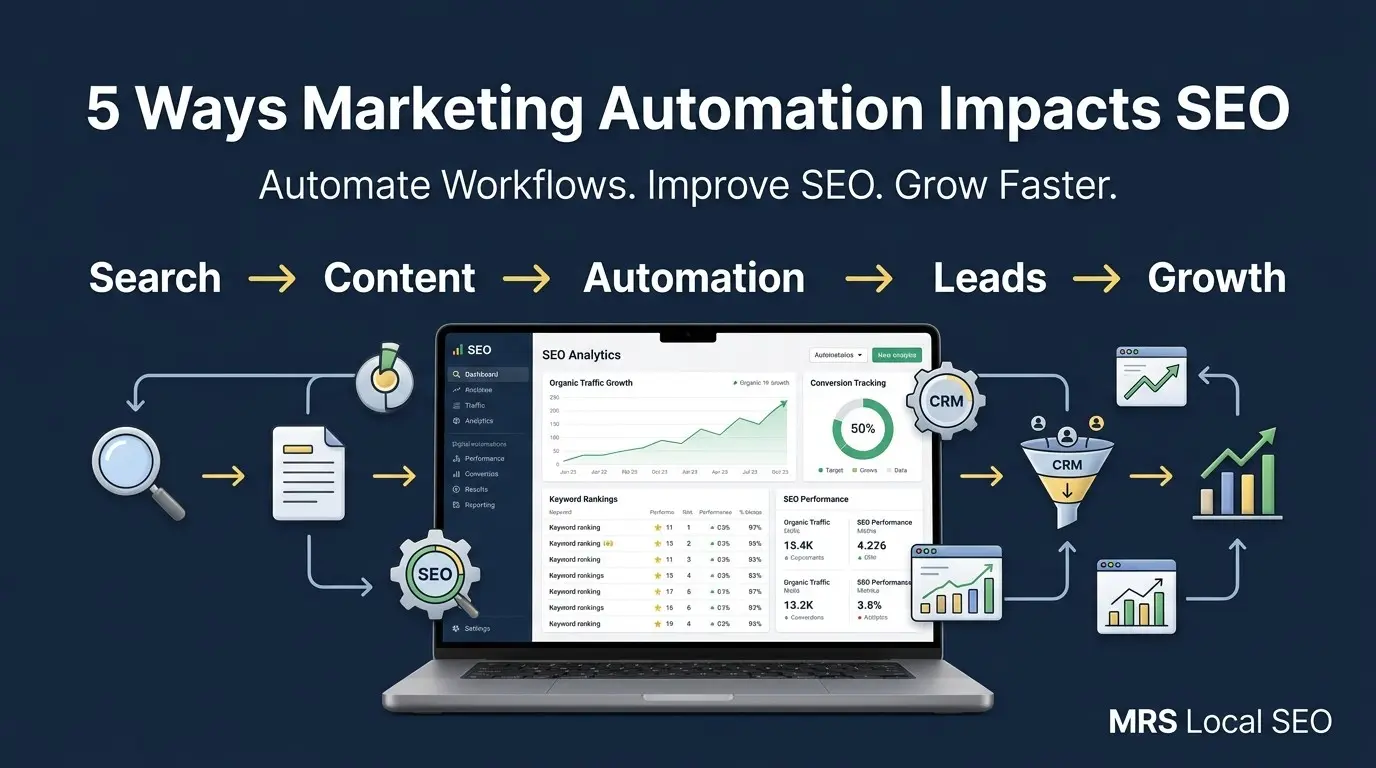
The 5 ways marketing automation impacts SEO include improving keyword research, scaling content production, creating personalized user experiences, connecting organic traffic with CRM systems, and automating SEO monitoring and optimization workflows.
However, marketing automation does not replace SEO strategy. Instead, it helps businesses save time, analyze better data, and create more effective workflows that support long-term organic growth.
According to MRS Local SEO, successful SEO automation is not about publishing more content automatically. It is about using the right technology, data, and human expertise to create valuable experiences for users and search engines.
Businesses that combine SEO with marketing automation can better understand their audience, improve customer journeys, and turn organic visitors into qualified leads.
Quick Answer: Does Marketing Automation Affect SEO?
Yes, marketing automation can positively support SEO by improving processes such as keyword research, content optimization, audience targeting, performance tracking, and lead nurturing.
However, automation itself does not directly increase Google rankings.
Search engines still evaluate factors such as:
- Content quality
- Search intent satisfaction
- Website experience
- Technical SEO
- Authority and trust
- User engagement
Marketing automation helps SEO teams perform these activities more efficiently by reducing repetitive work and providing better insights.
What Is Marketing Automation and How Does It Connect With SEO?
Marketing automation refers to using software and workflows to automate repetitive marketing tasks, including:
- Email campaigns
- Lead nurturing
- Customer segmentation
- Content distribution
- Data tracking
- Reporting
- Customer relationship management
SEO focuses on improving organic search visibility and attracting users through search engines.
When combined, marketing automation and SEO create a connected system:
Search user → Website visit → Content interaction → Lead capture → CRM tracking → Personalized follow-up → Conversion
Instead of viewing SEO only as a traffic source, businesses can understand how organic visitors behave after arriving on their website.
This allows companies to make better decisions about content creation, keyword targeting, and customer engagement.
5 Ways Marketing Automation Impacts SEO
1. It Automates Keyword Research and Search-Intent Analysis
Keyword research is one of the most important parts of SEO, but traditional research methods can be time-consuming.
Marketing automation helps businesses organize and analyze keyword opportunities faster by identifying:
- High-value search terms
- Content gaps
- Customer questions
- Search behavior patterns
- Topic opportunities
Automated Keyword Discovery
Modern SEO workflows can use automation tools to collect keyword data, analyze competitors, and identify topics that match audience needs.
For example, instead of manually searching hundreds of keywords, automation can help SEO teams group related terms into categories based on:
- Search volume
- Competition level
- User intent
- Conversion potential
Keyword Clustering and Topic Mapping
One major benefit of SEO automation is keyword clustering.
Instead of creating separate pages for every keyword variation, businesses can build comprehensive content around topic groups.
For example:
A business offering SEO services may target:
- Local SEO services
- SEO consulting
- SEO automation services
- Marketing automation strategy
- SEO reporting tools
Automation helps identify relationships between these keywords and creates a stronger content structure.
Matching Content With Search Intent
Google increasingly focuses on understanding what users actually want.
Marketing automation combined with SEO analytics helps businesses identify whether users are looking for:
- Information
- Solutions
- Comparisons
- Services
- Products
This improves content alignment and helps businesses create pages that better satisfy search intent.
2. It Scales SEO Content Production and Optimization
Creating high-quality content consistently is one of the biggest challenges businesses face.
Marketing automation helps streamline the SEO content workflow without removing human creativity and expertise.
Automation can support:
- Content planning
- Topic research
- Content briefs
- Publishing schedules
- Performance tracking
- Optimization workflows
Automated Content Briefs
SEO teams can create structured content briefs that include:
- Target keywords
- Search intent
- Related topics
- Competitor insights
- Recommended headings
- Internal linking opportunities
This improves consistency across content campaigns.
On-Page SEO Optimization
Marketing automation and SEO tools can assist with:
- Title optimization
- Meta descriptions
- Heading structure
- Keyword placement
- Internal linking recommendations
- Content updates
However, human review remains essential.
Automation can identify opportunities, but experienced SEO professionals ensure content remains useful, accurate, and aligned with audience needs.
Internal Linking and Content Workflows
Internal linking helps search engines understand website structure and content relationships.
Automation can identify:
- Relevant pages to connect
- Broken internal links
- Content clusters
- Linking opportunities
For businesses managing hundreds of pages, automated SEO workflows can significantly reduce manual work.
3. It Improves Personalization and User Engagement
SEO success is not only about attracting visitors. It is also about providing experiences that encourage users to stay, interact, and convert.
Marketing automation helps businesses understand visitor behavior through:
- Website activity
- Email interactions
- CRM data
- Previous content engagement
- Customer preferences
Behavioral Data and Audience Segmentation
Automation allows businesses to divide audiences into groups based on their interests and actions.
For example:
A visitor reading SEO blog content may receive educational resources, while someone viewing service pages may receive consultation-focused messaging.
This creates more relevant experiences.
Personalized Content Experiences
Personalization can improve:
- User engagement
- Time on site
- Return visits
- Conversion opportunities
When users find relevant content faster, they are more likely to continue interacting with a website.
Improving the Customer Journey
Marketing automation helps businesses understand the complete customer journey:
Awareness → Research → Consideration → Decision
SEO attracts users at the beginning of this journey, while automation helps guide them toward becoming qualified leads.
4. It Connects SEO Traffic With Lead Nurturing and CRM Data
One of the biggest advantages of combining SEO and marketing automation is connecting organic traffic with business results.
Many businesses measure SEO only through:
- Rankings
- Traffic
- Impressions
But the real goal is generating revenue.
Marketing automation connects SEO performance with:
- Lead generation
- Customer data
- Sales pipelines
- Conversion tracking
- Revenue attribution
Turning SEO Visitors Into Leads
A user who discovers a website through Google may not purchase immediately.
Automation helps businesses continue the relationship through:
- Email sequences
- Educational content
- Follow-up campaigns
- Personalized recommendations
Automated Lead Scoring
Lead scoring helps businesses identify which visitors are most valuable.
For example:
A visitor downloading an SEO guide, viewing pricing pages, and requesting information may receive a higher lead score than someone only reading a blog post.
CRM Integration and Revenue Attribution
Connecting SEO with CRM systems helps businesses answer important questions:
- Which keywords generate leads?
- Which pages create customers?
- Which content contributes to revenue?
This creates a more complete picture of SEO ROI.
MRS Local SEO focuses on helping businesses build measurable SEO systems where traffic, leads, and business growth are connected.
5. It Automates SEO Monitoring, Reporting and Content Updates
SEO is not a one-time activity. Search rankings, competitors, user behavior, and search engine algorithms continue to change.
Marketing automation helps businesses monitor performance and make faster improvements by automating important SEO tasks such as:
- Ranking tracking
- Organic traffic analysis
- Conversion monitoring
- Content performance evaluation
- SEO reporting
- Content refresh workflows
Tracking Rankings and Organic Traffic
Manual SEO reporting can take hours, especially for businesses managing multiple pages, locations, or campaigns.
Automation tools help track important performance metrics, including:
- Keyword ranking changes
- Organic traffic growth
- Search visibility
- Click-through rates
- Landing page performance
- User engagement
This allows SEO teams to quickly identify what is working and where improvements are needed.
For example, if a service page receives declining organic traffic, automated alerts can help identify the issue before it impacts lead generation.
Identifying Underperforming Content
Not every piece of content continues performing forever.
Search trends change, competitors publish new information, and user expectations evolve.
Marketing automation can help identify pages that need attention, including:
- Pages losing rankings
- Old blog posts
- Declining traffic pages
- Low-converting landing pages
- Outdated information
SEO professionals can then update these pages with:
- Fresh information
- Better keyword targeting
- Improved user experience
- Stronger internal links
Automating Content Refreshes and SEO Reports
Content freshness is an important part of maintaining search visibility.
Automation can support content update workflows by reminding teams when pages need:
- Keyword updates
- New statistics
- Improved formatting
- Additional sections
- Updated internal links
Automated SEO reporting also helps businesses understand:
- What content generates traffic
- Which keywords create opportunities
- How SEO impacts conversions
- Where marketing budgets should focus
Does Marketing Automation Directly Improve Google Rankings?
No, marketing automation does not directly improve Google rankings.
Google does not rank websites simply because they use automation software.
Search engines evaluate factors such as:
- Helpful and original content
- Website authority
- Technical performance
- Page experience
- Search intent satisfaction
- Trust signals
However, marketing automation can indirectly support rankings by helping businesses:
- Publish better-organized content
- Improve user experiences
- Identify content opportunities
- Monitor SEO performance
- Maintain website freshness
The right approach is:
Use automation to improve SEO processes, not to replace SEO strategy.
What Automation Can Improve vs What It Cannot Replace
What Marketing Automation Can Improve
Automation is highly effective for:
- Collecting SEO data
- Organizing keyword research
- Managing content workflows
- Tracking performance
- Segmenting audiences
- Supporting lead nurturing
- Creating reports
What Automation Cannot Replace
Human expertise is still required for:
- Strategic SEO planning
- Understanding customer needs
- Creating expert-level content
- Brand positioning
- Editorial decisions
- Technical SEO decisions
Successful SEO requires a balance between technology and human experience.
Marketing Automation vs SEO Automation: What’s the Difference?
Although these terms are often used together, marketing automation and SEO automation have different purposes.
Marketing Automation
Marketing automation focuses on improving the overall marketing funnel.
Common tasks include:
- Email automation
- Lead nurturing
- Customer segmentation
- CRM workflows
- Sales follow-ups
- Campaign management
The goal is to improve customer relationships and increase conversions.
SEO Automation
SEO automation focuses specifically on improving search engine optimization workflows.
Common tasks include:
- Keyword tracking
- SEO audits
- Technical monitoring
- Internal linking suggestions
- Content optimization
- Reporting
The goal is improving organic search performance.
Where They Overlap
The biggest impact happens when both systems work together.
For example:
A user searches Google → Finds an SEO-optimized page → Downloads a resource → Enters CRM → Receives personalized follow-up → Becomes a customer
This creates a complete marketing system instead of disconnected activities.
Benefits of Combining Marketing Automation With SEO
Businesses that combine SEO and marketing automation can achieve several advantages.
1. Save Time on Repetitive SEO Tasks
Automation reduces manual work by handling repetitive processes such as:
- Reporting
- Data collection
- Workflow management
- Performance monitoring
This allows SEO teams to focus on strategy and creativity.
2. Scale Content and Campaigns
Growing businesses often struggle to manage increasing content demands.
Automation helps teams organize:
- Content calendars
- Publishing workflows
- Optimization processes
- Multi-channel campaigns
This makes scaling SEO efforts easier.
3. Improve Lead Nurturing
SEO brings potential customers to a website, but many visitors are not ready to buy immediately.
Automation helps businesses stay connected through:
- Email sequences
- Personalized recommendations
- Educational resources
- Follow-up campaigns
4. Connect SEO With Revenue
One of the biggest advantages of marketing automation is better measurement.
Businesses can understand:
- Which keywords generate leads
- Which pages influence purchases
- Which campaigns create revenue
This helps prove SEO value beyond rankings.
5. Make Data-Driven SEO Decisions
Automation provides valuable insights that help businesses improve their strategies.
Instead of guessing what works, businesses can use real performance data to make decisions.
Risks of Using Marketing Automation for SEO
Although automation provides many benefits, using it incorrectly can create problems.
Low-Quality Automated Content
One common mistake is creating large amounts of AI-generated or automated content without proper review.
Poor-quality content can:
- Reduce user trust
- Fail to answer search intent
- Provide little value
- Hurt brand reputation
Human editing and expertise remain essential.
Over-Optimization
Automation tools may suggest excessive keyword usage or unnatural optimization.
SEO should always prioritize:
- Readability
- User experience
- Natural language
- Helpful information
Incorrect Keyword Targeting
Automation can identify keyword opportunities, but businesses still need strategic evaluation.
A keyword may have high search volume but low business value.
Professional SEO analysis is required to choose keywords that attract the right audience.
Poor Personalization
Automation without proper audience understanding can create generic experiences.
Effective personalization requires:
- Accurate customer data
- Clear segmentation
- Relevant messaging
Losing Human Editorial Oversight
Technology should support marketers, not replace them.
The strongest SEO results come from combining:
- Automation efficiency
- Human creativity
- Industry expertise
- Strategic decision-making
How to Build an SEO-Friendly Marketing Automation Workflow
A successful workflow requires planning, technology, and continuous improvement.
Step 1: Identify Your SEO and Business Goals
Start by defining what you want automation to achieve.
Examples:
- Increase organic traffic
- Generate more leads
- Improve content performance
- Track SEO ROI
Step 2: Map Keywords to the Customer Journey
Connect keywords with different stages:
Awareness Stage
Users search for educational information.
Example:
“What is marketing automation?”
Consideration Stage
Users compare solutions.
Example:
“Best marketing automation tools for SEO”
Decision Stage
Users search for providers.
Example:
“SEO automation services”
This helps create content that supports the complete buying journey.
Step 3: Connect Your Website, CRM and Analytics
Integrate platforms such as:
- Website analytics
- CRM systems
- Marketing platforms
- SEO reporting tools
This creates a complete view of customer behavior.
Step 4: Create Automated Content and Lead Workflows
Build systems for:
- Content publishing
- Email follow-ups
- Lead nurturing
- Performance tracking
Step 5: Monitor Rankings, Leads and Conversions
Regularly review:
- Organic traffic
- Search visibility
- Lead quality
- Conversion rates
Step 6: Keep Human Review in the Process
Always maintain expert review for:
- Content quality
- SEO strategy
- Customer messaging
- Brand reputation
Automation works best when combined with professional expertise.
When Should a Business Use Marketing Automation for SEO?
Marketing automation is not only for large companies. Businesses of different sizes can benefit from combining automation with SEO when they have clear goals and enough data to create meaningful workflows.
The right time to consider marketing automation is when manual marketing tasks start limiting growth.
Small Businesses
Small businesses often have limited time and resources.
Automation can help small businesses manage:
- SEO reporting
- Customer follow-ups
- Content planning
- Lead management
- Audience communication
Instead of spending hours on repetitive tasks, business owners can focus on improving services and customer relationships.
For local businesses, combining local SEO with marketing automation can be especially valuable because it helps convert nearby search users into qualified leads.
SaaS Companies
SaaS businesses usually depend on consistent content marketing and organic visibility.
Marketing automation can help SaaS companies:
- Track user behavior
- Personalize onboarding
- Nurture free users
- Identify high-value prospects
- Connect content engagement with conversions
E-commerce Businesses
E-commerce brands can use automation to improve the connection between SEO traffic and sales.
Examples include:
- Personalized product recommendations
- Abandoned cart workflows
- Customer segmentation
- Product content optimization
- Purchase journey tracking
B2B Companies
B2B businesses often have longer buying cycles.
Marketing automation helps manage complex customer journeys by connecting:
- SEO content
- Lead capture forms
- CRM systems
- Sales follow-ups
- Lead scoring
Agencies and Growing Marketing Teams
Marketing agencies and internal marketing teams can use automation to improve efficiency when managing multiple campaigns.
Automation helps teams handle:
- Client reporting
- SEO audits
- Content workflows
- Performance tracking
- Campaign coordination
How to Choose a Marketing Automation or SEO Automation Solution
Choosing the right platform depends on your business goals, marketing processes, and growth stage.
A good solution should support both automation capabilities and strategic SEO needs.
SEO Features
Look for tools that support:
- Keyword tracking
- Search visibility monitoring
- Technical SEO analysis
- Content optimization
- Reporting
CRM Integration
A strong marketing automation platform should connect with customer relationship management systems.
CRM integration helps businesses understand:
- Where leads come from
- How visitors interact with content
- Which campaigns create customers
Analytics and Attribution
Data is one of the most important parts of modern SEO.
Your automation system should help measure:
- Organic traffic performance
- Lead generation
- Conversion rates
- Customer acquisition sources
- SEO ROI
Workflow Flexibility
Every business has different processes.
Choose solutions that allow customization for:
- Email sequences
- Lead nurturing
- Content workflows
- Reporting schedules
- Customer segmentation
Scalability
A good platform should support future growth.
Consider whether it can handle:
- More website traffic
- Additional campaigns
- Multiple locations
- Larger customer databases
Human Oversight
The best marketing automation systems still require expert management.
Technology provides data and efficiency, but strategy determines success.
Why Choose MRS Local SEO for Marketing Automation and SEO Strategy?
At MRS Local SEO, we believe automation should make SEO smarter, not replace the expertise behind successful digital marketing.
Many businesses invest in SEO tools but struggle to turn data into meaningful growth. The problem is usually not a lack of technology—it is the lack of a clear strategy.
Our approach combines:
- SEO expertise
- Marketing automation workflows
- Data analysis
- Local search optimization
- Conversion-focused strategies
We help businesses build systems that connect:
Search visibility → Website traffic → Leads → Customer relationships → Business growth
Experience-Based SEO Strategy
Every business has different goals, audiences, and challenges.
A successful automation strategy requires understanding:
- Customer behavior
- Industry competition
- Search intent
- Conversion opportunities
- Business objectives
MRS Local SEO focuses on creating practical strategies instead of using automation without direction.
Data-Driven Optimization
We use performance insights to identify:
- Content opportunities
- SEO improvements
- Conversion barriers
- Growth opportunities
Automation helps collect information, while our SEO expertise helps turn that information into action.
Human-Focused Content and SEO
Search engines continue becoming better at understanding useful content.
That means businesses need content that demonstrates:
- Experience
- Expertise
- Authority
- Trust
Automation can support content workflows, but valuable information still requires professional strategy.
Local SEO and Marketing Automation: Why It Matters for Businesses
For local businesses, visibility in search results is only the first step.
The real goal is attracting qualified customers who are ready to take action.
Local SEO combined with marketing automation helps businesses:
- Capture local search traffic
- Follow up with potential customers
- Track customer journeys
- Improve lead quality
- Increase conversions
For example:
A customer searches for a local service → Visits the website → Requests information → Enters a follow-up workflow → Receives relevant communication → Becomes a customer
This creates a complete system instead of relying only on rankings.
Businesses looking to improve their online visibility can explore MRS Local SEO’s SEO services, learn more about the team through the About Us page, and connect with experts through the Contact Us page.
Marketing Automation and SEO: Frequently Asked Questions
Does marketing automation help SEO?
Yes, marketing automation can support SEO by improving workflows, tracking performance, organizing data, and helping businesses create better user experiences.
However, automation does not replace SEO strategy or guarantee higher rankings.
Does marketing automation improve Google rankings?
Marketing automation does not directly improve rankings.
It supports SEO activities such as content optimization, reporting, audience analysis, and workflow efficiency, which can contribute to better SEO performance.
Can SEO be fully automated?
No. Some SEO tasks can be automated, but complete SEO automation is not recommended.
Tasks such as reporting, tracking, and data collection can be automated, while strategy, content quality, and decision-making require human expertise.
What SEO tasks can be automated?
Common automated SEO tasks include:
- Keyword tracking
- SEO reporting
- Website monitoring
- Content performance analysis
- Internal linking suggestions
- Workflow management
Can marketing automation hurt SEO?
Yes, if used incorrectly.
Problems may occur when businesses rely on low-quality automated content, ignore user experience, or use automation without proper SEO oversight.
What is the difference between marketing automation and SEO automation?
Marketing automation focuses on customer journeys, lead nurturing, and marketing workflows.
SEO automation focuses specifically on improving search optimization tasks such as tracking rankings, audits, and content improvements.
Is SEO automation worth it for small businesses?
Yes, especially when small businesses want to save time and improve efficiency.
The key is using automation strategically while maintaining quality and customer-focused content.
What are the best marketing automation tools for SEO?
The best tools depend on business goals.
Important features include:
- SEO tracking
- Analytics
- CRM integration
- Workflow automation
- Reporting capabilities
Businesses should choose tools based on their specific needs rather than only popularity.
Should I hire an SEO automation agency?
Businesses should consider working with an SEO automation agency when they need expert guidance, technical support, scalable workflows, or help connecting SEO performance with business growth.
An experienced agency can help create a strategy that combines automation efficiency with professional SEO expertise.
Final Takeaway: Use Automation to Scale SEO, Not Replace Strategy
Marketing automation has changed how businesses approach SEO.
The biggest value is not replacing marketers or creating endless automated content. The real benefit is improving efficiency, understanding customer behavior, and creating smarter workflows.
The 5 ways marketing automation impacts SEO show how automation can support:
- Keyword research
- Content optimization
- User personalization
- Lead nurturing
- SEO reporting
When combined with strong SEO fundamentals, automation can help businesses create better experiences, generate qualified leads, and make more informed marketing decisions.
At MRS Local SEO, we help businesses build SEO and automation strategies designed around real growth—not just rankings.
Ready to understand where automation can improve your SEO workflow?
Get an SEO & Marketing Automation Audit from MRS Local SEO today and discover opportunities to improve visibility, leads, and conversions.