
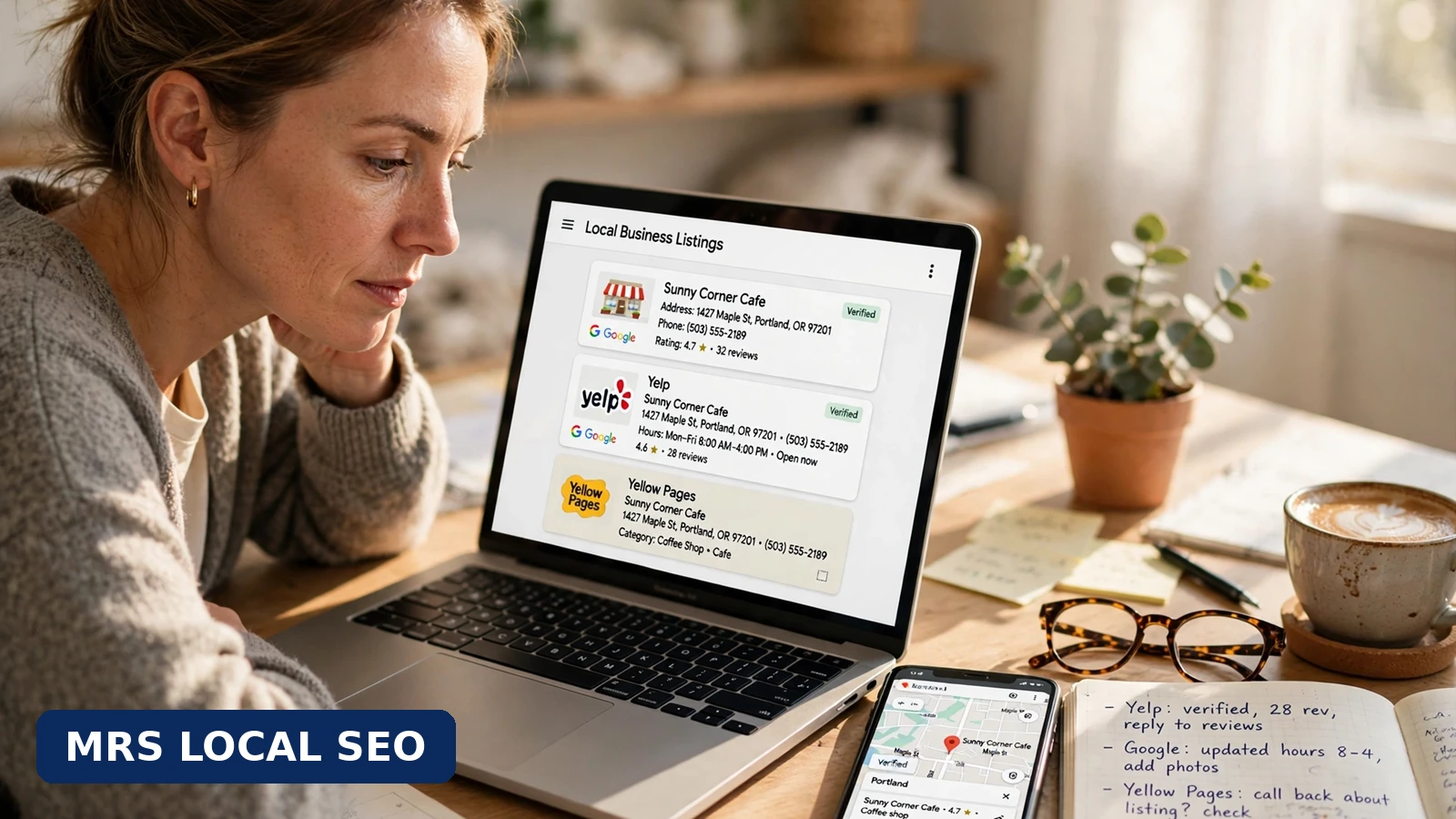
Local citations are online mentions of a business's name, address and phone number (NAP), with or without a link. They help search engines and customers confirm that your business is real, located where it says it is, and reachable on the right number.
If you manage your own Google Business Profile, you have probably seen your business listed on sites you never created. Those listings are citations. Some are helpful. Some contain old details. This article explains what citations are, where they come from, why accuracy matters, and how to build and audit them without wasting time or money.
What Is a Local Citation, in Plain Language?
A local citation is any place on the web where your business's NAP appears. A link isn't required. A mention in a directory, a review site, a map platform or a local news article can all count as citations.
Citations came out of a simple idea. The web is full of conflicting business data, and search engines need a way to check which version is right. If the same name, address and phone number appear in many trusted places, the business looks more established and easier to verify. If the details keep changing, confidence drops.
One note on terminology: "Google My Business" is the legacy name for what Google now calls Google Business Profile (GBP). Some directories still use the old name, but they refer to the same product.
Structured vs. Unstructured Citations
There are two kinds of citation, and they play different roles.
Structured citations are NAP listings in a standard format. They live in business directories, review sites, map platforms and data aggregators. They are the listings you can usually claim, edit and monitor.
Unstructured citations are mentions inside ordinary pages. Examples include a local news article, a blog post about a neighbourhood business, or a social media post that lists your address. You can't always edit these, but they still help confirm your details.
Both count. Most small businesses should start with structured listings, because they are easier to control, and treat unstructured mentions as a useful bonus.
Why NAP Consistency Is the Whole Point
Citation work comes down to one rule: the same name, address and phone number should appear the same way everywhere it matters.
When details differ, search engines can't be sure which version is correct. A business listed as "Brightwater Plumbing LLC" on one site, "Brightwater Plumbing & Heating" on another, and with an old phone number on a third creates three slightly different identities. Customers face the same problem: they call a disconnected number or drive to an old address.
Consistency does not mean identical punctuation down to the comma. It means no conflicting facts. Pick one official name, one address format and one main phone number, and use them everywhere you control.
Where Do Local Citations Live?
Citations sit in several layers, and the layers feed each other:
- Data aggregators. These are companies that collect business data and supply it to many directories and apps. One wrong record here can spread to dozens of sites, so checking them first saves repeated fixes.
- General directories and map platforms. Examples are Google Business Profile, Apple Business Connect, Bing Places and Facebook business pages. These are the listings customers see most.
- Industry-specific directories. These cover your trade, such as legal, medical, home services or restaurants.
- Local directories. Chamber of commerce pages, city business lists and neighborhood sites fall here.
- Review sites. These are listings customers actually read and use.
Citations Table: What to Check by Type
| Citation type | Where it appears | What to check |
|---|---|---|
| Data aggregator record | Behind many directories | Name, address, phone and category are correct |
| General directory / map platform | Google, Apple, Bing, Facebook | Profile claimed, details match your official format |
| Industry directory | Trade or professional sites | Right category, accurate services, active site |
| Local directory | Chamber, city, community sites | Current address, working website link |
| Review site | Customer review platforms | Claimed listing, no duplicates, replies to reviews |
| Unstructured mention | News, blogs, social posts | Details correct; request a correction if wrong |
Why Do Local Citations Matter for Local Search?
Google's Business Profile Help page says local results are mainly based on relevance, distance and prominence. Relevance is how well a profile matches the search. Distance is how far the business is from the searcher or the searched place. Prominence is how well known the business is, based on information across the web, including links, articles and directories.
That page does not name citations as a ranking factor, and no official Google document gives citations a specific weight. So treat the common claim that "citations are a top 3 local ranking factor" with care: it is an industry interpretation, not a Google statement.
What is safe to say, based on what Google does publish:
- Documented: Google says complete, accurate business information makes a profile more likely to appear in local results.
- Professional judgement: Consistent citations help search engines verify your details and reinforce your business's identity across the web.
Citations support the trust that your reviews, website and Google Business Profile build on. They don't replace those things, but they back them up. For the difference between keeping a profile tidy and actively managing it, see GBP optimization vs. GBP management.
How to Build Local Citations Step by Step
For a single-location business in 2026, a sensible order looks like this:
- Lock your official business details. Write down your exact name, address, phone number, website, hours and primary category. This is your single source of truth, and every listing should match it.
- Claim the core platforms first. Start with Google Business Profile, then Apple Business Connect, Bing Places and Facebook. Verify ownership where the platform asks for it.
- Check the data aggregators. Confirm what the major ones hold about you, and correct any errors at the source.
- Add industry directories. Choose the two to five that people in your trade and city actually use.
- Add local listings. Chamber of commerce, city and community directories show you are part of the local area.
- Fill each listing completely. Add the category, hours, website, description and photos where the site allows.
- Record everything. Keep a spreadsheet of site, login, URL, date and any notes.
If you run a service area business and have no customer-facing location, don't invent an address to get listed. Google's guidelines for representing your business state that a rented mailing address or virtual office where you don't operate isn't eligible for a Business Profile. For the wider checklist around this work, see The Complete Local SEO Checklist for 2026.
How to Audit and Clean Up Existing Citations
Most businesses already have citations they didn't create. A first audit usually looks like this:
- Search for yourself. Search your business name, old names, old phone numbers and old addresses. Note every listing you find.
- List the problems. Mark wrong details, duplicates, and listings on sites that look abandoned.
- Fix what you can control. Claim the listing and correct it.
- Merge or remove duplicates. Follow each platform's duplicate-reporting or merge process. Don't create a new listing to work around a duplicate.
- Request corrections on unstructured mentions. Ask the site owner to update an article or page.
- Recheck in a few weeks. Corrections can take time to spread, especially across aggregator-fed sites.
For a single-location business, a first check realistically takes a few hours. That is my professional estimate, not a published benchmark, and it depends on how many listings exist. For more detail, see How to Do a Local SEO Audit Step by Step.
A Worked Example (Hypothetical)
This example is invented for illustration. It is not a client result.
Brightwater Plumbing is a fictional one-van plumbing business in Columbus, Ohio. It moved offices twice, changed its phone number once, and never checked its listings. When the owner searched, the picture looked like this:
| Citation area | Before | The problem | The fix |
|---|---|---|---|
| Name | "Brightwater Plumbing LLC" and "Brightwater Plumbing & Heating" | Two versions of the name | Use one official name everywhere |
| Address | Old suite on two directories | Customers sent to the wrong place | Update to the current address |
| Phone | Old number on an aggregator-fed site | Wrong number spreads to other sites | Correct at the aggregator, then recheck |
| Duplicates | Two listings on one review site | Reviews split across two records | Claim the main listing, report the duplicate |
| Local presence | No chamber or local listing | Few local mentions | Add the chamber and city directory listings |
After the cleanup, every core listing shows the same name, address and phone number, and one listing collects all the reviews. The business hasn't bought anything new. It has simply made its public record consistent.
Common Citation Mistakes to Avoid
- Inconsistent NAP. Variations in name, suite number or phone number create doubt.
- Duplicate listings. They split your reviews and confuse customers and search engines.
- Low-quality or irrelevant directories. A listing only helps if the site is real, relevant and actually used. Paying for hundreds of listings on sites nobody visits adds little and can create cleanup work later.
- Keyword-stuffed business names. Google says unnecessary information in a business name isn't permitted and could lead to suspension. Use your real-world name.
- Fake locations. Virtual offices and invented addresses create eligibility and suspension risk.
- Fake reviews. They damage trust and can get a profile penalized. Ask real customers instead.
- Treating citations as a one-time job. Move, rebrand or change your number, and every listing needs updating.
Doing It Yourself vs. Hiring Help
Do it yourself if you have one location, stable details and a few hours to spare. The core platforms are free to claim, and the steps above are the work.
Consider hiring help if you have several locations, you have changed names or addresses, you have many duplicates, or you don't have time to keep listings current. How Local SEO Services Help Small Businesses Get More Customers explains what professional support involves.
Realistic Timelines and What to Measure
Nobody can promise a ranking result from citations. In my experience, accuracy fixes show up as fewer wrong-number calls and fewer customers going to the wrong place, rather than an overnight ranking jump.
Each month, check:
- Whether name, address and phone still match across your core listings.
- New duplicates or unexpected listings.
- Calls, direction requests and website clicks in your Business Profile performance data.
- Review volume and your replies.
How Often Should You Update Your Google Business Profile? covers the Profile side of this routine.
Frequently Asked Questions
What are local citations?
Local citations are online mentions of a business's name, address and phone number, with or without a link. They help search engines and customers confirm a business is real and reachable.
How long does local citation work take to show results?
Fixes to wrong details can appear in a few weeks, but changes in local visibility often take a few months.
Can I do citation building myself, or should I hire an expert?
A single-location business with stable details can usually do it themselves. Hiring help makes sense with several locations, messy duplicates or frequent changes.
How does citation building affect my Google ranking?
Google doesn't publish a citation ranking factor. It says local results rest mainly on relevance, distance and prominence, and that complete, accurate business information helps a profile appear in local results.
Do unlinked mentions of my business count?
Yes. A citation doesn't need a link. An unlinked mention of your name, address and phone number still counts as a citation.
Should I pay for a package of hundreds of listings?
Generally no. Quantity isn't the goal. A smaller set of accurate, relevant listings on real sites is more useful than hundreds of listings on sites nobody uses.
Conclusion
Local citations are the web's record of who your business is and where to find it. Accurate and consistent citations help search engines trust your details and help customers reach you on the first try.
Your next step is small: write down your official name, address and phone number, then search for yourself and fix what doesn't match. If you'd rather have someone else handle the checking and the cleanup, MRS Local SEO offers local citations support as part of its local SEO services. If you're still working out your next move, start with What Is Local SEO? A Complete Guide for Small Businesses.